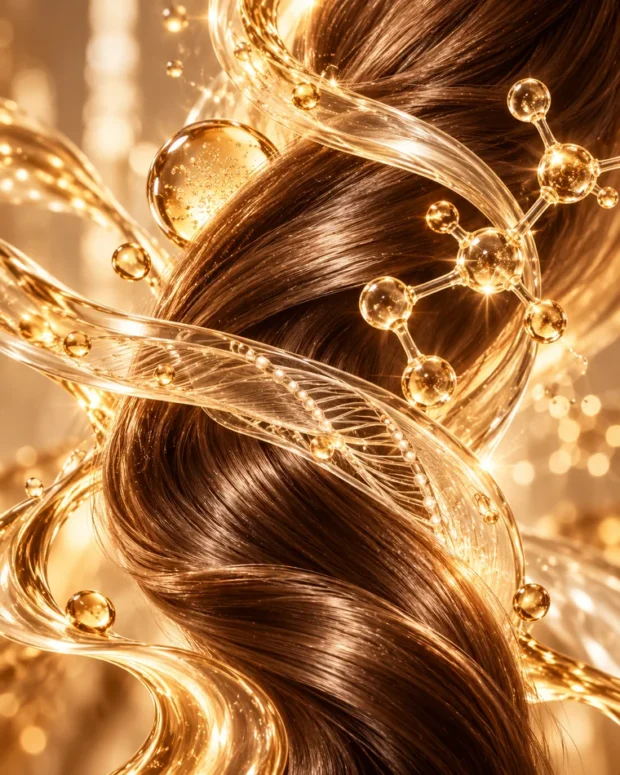
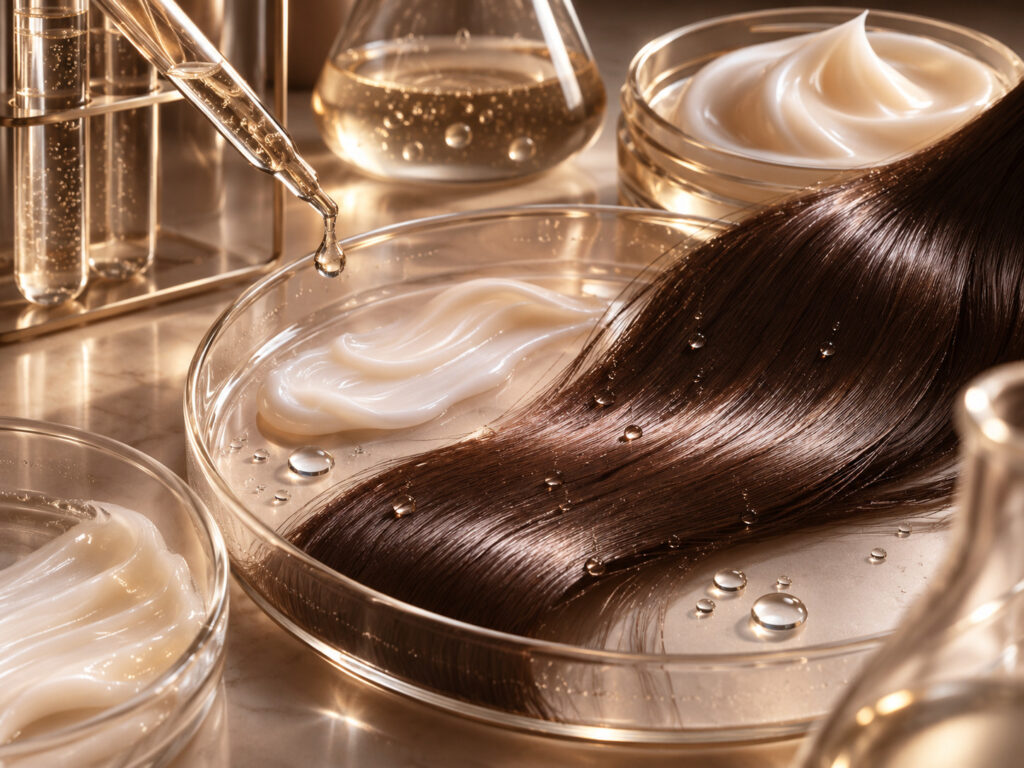
Beneath the drop / Rosemary oil for hair Rosemary oil for hair: One drop. A thousand questions. A botanical secret. A viral promise. And one question worth looking beneath the surface to answer: can rosemary oil really change your hair story? Not a miracle in a bottle. A story worth examining. The answer does not live on the strand. It begins beneath it. A closer look at the scalp Under the hair, a living world. The strand is only the beginning What you see in the mirror is the hair shaft. What determines new growth sits deeper, inside the follicle and the living scalp that surrounds it. Why rosemary caught attention Researchers have explored rosemary compounds for anti-inflammatory and antioxidant activity, and proposed possible effects on scalp circulation. These mechanisms are still being investigated. Mechanism is not proof An ingredient may look promising in the lab without reliably changing human hair growth. Real people, real measurements, and enough time are what test the claim. A scientific illustration — not a demonstrated treatment effect The surface The follicle The unanswered question Stylized scalp anatomy · not to scale The evidence, without the filter What did six months actually show? A study with 100 participants is a beginning, not a promise. A result in one hair-loss condition does not automatically apply to everyone. At the beginning Rosemary oil versus minoxidil 2%. A 2015 randomized comparative trial assigned 100 people with pattern hair loss to two groups for six months. There was no placebo group. After three months Too soon to detect a significant change. Mean hair count had not changed significantly from baseline in either group at the three-month assessment. After six months A signal worth studying. Not proof of equivalence. Both groups had significant hair-count increases from baseline. No statistically significant between-group difference was detected, but that does not establish that the treatments work equally well. BaselineMonth threeMonth six Source: Panahi et al., Skinmed (2015) Read the study Evidence limitations Promising ≠ guaranteed The Rosemary Scalp Lab Your scalp. Your rules. Explore a real choice, not a magic result. Select a rosemary product, describe your scalp, choose a goal and run an animated care check to see what matters most. Living scalp / illustratedBalanced caution The scalp surfaceA concentrated essential oil can irritate the skin; how a product is formulated matters. Design a safer ritual.These choices change the guidance and the animated visual. They do not predict hair growth.✳ Choose your rosemary formula Diluted blend Ready-made scalp serum Pure essential oil Describe the scalp today Comfortable Sensitive Irritated or inflamed What brings you here? Hair thinning Botanical ritual Scalp feel Run the scalp care check↗ The careful starting point Respect the scalp. Keep expectations real. A diluted product on a comfortable scalp is a more cautious way to explore a botanical ritual. This is not a promise of regrowth. A note worth carrying with you: the 2015 trial studied people with pattern hair loss. It does not show that every rosemary oil, shampoo or formula works for every cause of hair loss. Sudden, patchy, painful, inflamed, or unexplained shedding merits a professional assessment. Essential oils can cause irritation or allergy. Read the safety and research notesDo not apply undiluted rosemary essential oil directly to the scalp. Follow the directions of a properly formulated product, keep it away from eyes, test a small area cautiously, and stop if redness or itching develops. A patch test does not guarantee that a reaction cannot happen. For independent context, read the 2015 trial, the 2025 evidence review, and the essential-oil allergy study. The science · the question · the ritual