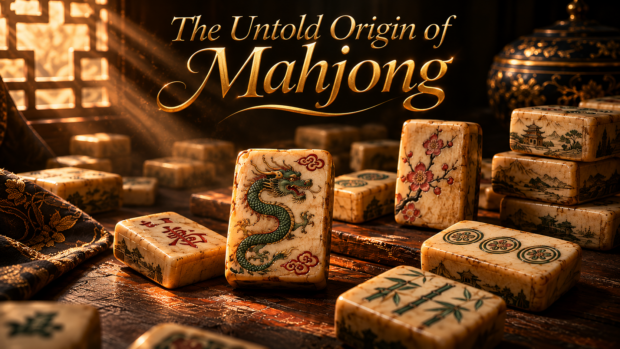
ORIGIN MAHJONG ORIGIN / AN UNFINISHED HISTORY WhereMahjongBegan. Who invented mahjong? No single inventor is known. The game emerged in nineteenth-century China. To find its beginning, follow the tiles—not the legend of the person who supposedly made them. THE LEGENDS / MYTH IS NOT EVIDENCE LEGEND AN ANCIENT SAGE LEGENDConfuciusnever left a set.One familiar tale has Confucius inventing the game more than two thousand years ago. The attractive association gives mahjong the prestige of a philosopher and an ancient Chinese past.But no contemporary evidence links Confucius to mahjong. The story belongs to folklore, not the documented history of the tiles. THE PALACE LEGENDAn imperialinvention?Another version places its birth behind palace doors, as a private entertainment devised for the ancient court. In the Western boom of the 1920s, advertising often encouraged exactly this exotic, aristocratic fantasy.Qing elites did play mahjong, but elite players are not proof of an ancient imperial inventor. Richly made sets tell us who enjoyed a game, not who first devised it. THE BATTLEFIELD LEGENDA general.A clever plan.Stories also credit military leaders with making a diversion for soldiers during nineteenth-century unrest. Such accounts are memorable because they turn a gradual invention into a dramatic single moment.Yet the named hero keeps changing. The sources do not establish one inventor. The more persuasive story begins with ordinary games passing between ordinary hands. THE EVIDENCE / THE LATE QING 1872–73Early surviving tile sets collected in China. 1889–90Documented sets acquired around Ningbo and Shanghai. 1901A tile set collected in Shanghai. THE RIVER PORTSLook east.Look closer.Mahjong's precise birthplace remains contested. The strongest trail leads into the late Qing dynasty, in the nineteenth century, and to the trading world of eastern China.Ningbo and Shanghai recur in early records. These ports connected merchants, travelers, craftspeople, and the changing habits of city life. SURVIVING OBJECTSWhat the tilescan prove.Researchers have traced surviving early sets to collections made in the 1870s, decades before the international craze. Later documented sets in Ningbo and Shanghai show the game developing and circulating.The tiles are firmer evidence than a perfect founding story, but they do not tell us the date of a first game—or identify the first player. AN UNSETTLED CREDITNo signatureon the wall.A local Ningbo tradition names Chen Yumen as the inventor. Historians have discussed it, but a late account and sparse contemporary documentation make any definite attribution unsafe.Instead, the evidence suggests a game refined through use: rules adjusted, sets remade, and familiar mechanics recast into a new social ritual. SCHEMATIC ROUTE · EDITORIAL RECONSTRUCTION, NOT ARCHIVAL PHOTOGRAPHY THE ANCESTORS / BEFORE THE WALL Before tiles,another game.Mahjong was not conjured from nothing. Its vocabulary of suits, draws, discards, and combinations grew alongside older Chinese pastimes. Its ancestors had traveled through changing social worlds long before a recognizable mahjong wall appeared on a table. Money-suited Chinese cards, including madiao, are a crucial part of the family tree. A deck could carry values through paper rather than heavy tiles. Players already knew the pleasures of counting suits, combining pieces, and anticipating a rival’s intentions. Chinese domino and tile traditions also matter. How those traditions joined is debated; what is clear is that the newer game reused and transformed earlier ideas. Materials changed the feel of play: paper shuffled softly, while solid pieces struck the table with an unmistakable sound. By the late nineteenth century the recognizable tile-game tradition was taking form. Compare the older materials with the quiet ivory wall on the right. EARLIER GAMESLATER TILES CardsMoney suits and numbered values. DominoesFamiliar hands-on tile traditions. Early setsA changing tile game gains form. THE JOURNEY / ACROSS THE WATER 1920s THE GAME TRAVELSNot one route.Many crossings.Before the global craze, the game spread through China's cities and social circles. In Shanghai, encounters between Chinese players, merchants, and visitors helped carry it further.Its passage abroad was not a single voyage. Rules and sets traveled with people, then changed as each new audience learned to play. Even the game’s name acquired different spellings as publishers tried to capture unfamiliar sounds in English. JAPANA new rhythmin the east.Mahjong reached Japan in the early twentieth century. Japanese accounts describe growing interest in the 1910s and popular clubs and salons during the 1920s.In Japan the rules continued to evolve, eventually producing a distinctive style of play. The pieces were familiar; the decisions and scoring took their own course. The story illustrates how a shared game can become local without losing its roots. THE WESTThen the worldcaught fire.In the early 1920s, mahjong became a sensation in the United States and Europe. Joseph P. Babcock's simplified English-language rules helped new players enter the game.Shanghai manufacturers scaled up production for foreign buyers. In American advertising, romantic claims about ancient Chinese courts often traveled faster than reliable history. The craze created beautiful objects, bustling commerce, and enduring misconceptions at the same time. THE PRESENT / SHARED ACROSS GENERATIONS A LIVING GAMEThe wallis still warm.Mahjong lives in family homes, community clubs, and competitive circles. The familiar clack of tiles can mark a reunion, a weekly ritual, or an afternoon among friends.For many players the table is as much about conversation and company as calculation. It becomes a place where experienced hands teach younger ones, where rhythms become familiar, and where an ordinary evening gains a sense of occasion. MANY WAYS TO PLAYOne name.Many rules.Chinese regional forms, Japanese riichi, and American mah jongg do not play identically. They share a family resemblance while differing in hands, scoring, and customs.In the United States, women players helped sustain and reshape the game long after the 1920s fad had faded. The National Mah Jongg League, founded in 1937, helped establish a distinctive American form with its own traditions. WHY IT ENDURESThe next handbegins.Luck can upset a careful plan. Skill emerges through attention, memory, risk, and the choices of three other people. That balance makes another game irresistible.Mahjong's history is not a frozen antique. It keeps being made each time a new group gathers around the wall. Each generation inherits something and then plays it a little differently. THE ANSWER / A STORY STILL IN PLAY Every wallhas a beginning. No proven personinvented mahjong;it evolved innineteenth-centuryChina. The clearest historical answer points toward Ningbo, Shanghai, and earlier Chinese card and tile games—not to a philosopher, emperor, or general.What survived is bigger than any invention myth: a table, a wall, four places to sit, and the sound of another hand. History leaves some questions open; the game invites everyone to join the next round. THE QUESTIONS THAT REMAIN Beyondthe legend. Who invented mahjong?No single inventor is established by reliable contemporary evidence. The game developed in nineteenth-century China, especially around Ningbo and Shanghai. A later Ningbo tradition credits Chen Yumen, but historians cannot treat that attribution as proven. How old is mahjong, really?Mahjong as a recognizable tile game dates to the nineteenth century. Some of the earliest surviving related sets were collected in the 1870s. The paper-card and tile games from which it developed are older, but that does not make modern mahjong thousands of years old. Did Confucius create mahjong?No reliable evidence supports that claim. It is a legend that became especially useful to marketers during the international mahjong craze of the 1920s. The ancient-court version is similarly unsupported as a story of invention. Which games influenced mahjong?Scholars point to Chinese money-suited playing cards, including madiao, and to tile and domino traditions. The exact family tree is debated; mahjong combined and revised pre-existing mechanics rather than arriving fully formed. When did mahjong spread to Japan and the West?It reached Japan in the early twentieth century and took off there during the 1920s. The United States and Europe experienced a major mahjong boom in the early 1920s, helped by mass-produced sets and English-language rules associated with Joseph P. Babcock. A HISTORY WRITTEN IN HANDS