INDEPENDENT INSTITUTIONAL BRAND PROFILE / EDITION 2026
The architecture of progress.
The World Bank is often recognized by a globe. Its real visual language, however, extends far beyond a symbol: into finance, research, infrastructure, public institutions and the systems that shape daily life. This is an independent editorial interpretation of that role.
EDITORIAL ARTWORK: Conceptual illustrations, not documentary photographs, official logos or evidence of individual World Bank projects.
PROLOGUE / READING THE INSTITUTION
A brand measured beyond its mark.
The World Bank is not a consumer bank. In this profile, the brand is considered as a public-facing institutional system: its purpose, structure, language, trust signals and practical implications.
“An institution can be recognized by its identity. Its value is ultimately judged by the difference its work makes.”Independent editorial interpretation — not an official World Bank quotation
CHAPTER 01 / THE INSTITUTION
From reconstruction to development.
The World Bank traces its origins to the 1944 Bretton Woods conference. The International Bank for Reconstruction and Development (IBRD) later became part of a broader development architecture. The World Bank itself refers to IBRD and the International Development Association (IDA). The wider World Bank Group encompasses other institutions with different mandates.
Reconstruction
The original institution emerged in a post-war setting. Its role evolved toward development financing and knowledge.
IBRD + IDA
IBRD and IDA together constitute the World Bank. Their financing approaches and eligible borrowers differ.
Different instruments
The World Bank Group also includes institutions focused on the private sector, guarantees and investment-dispute settlement.
THE CONTEXT / NOT A CLAIM OF PERFECT CONTINUITY
A few lasting milestones.
Institutional history is useful as a framework, not a substitute for evaluating the results of individual policies.
Bretton Woods
The IBRD was conceived during the Bretton Woods meetings.
IBRD operations
The IBRD began operations.
IDA established
IDA was created to support eligible lower-income countries through concessional financing.
An evolving mandate
Financing, technical expertise, research and partnerships intersect with development debates and changing country priorities.
CHAPTER 02 / THE VISIBLE ECONOMY
Development is not an abstraction.
Infrastructure and public services make development visible, but these conceptual scenes do not depict verified World Bank-funded projects.
CHAPTER 03 / HOW THE SYSTEM WORKS
Finance meets knowledge.
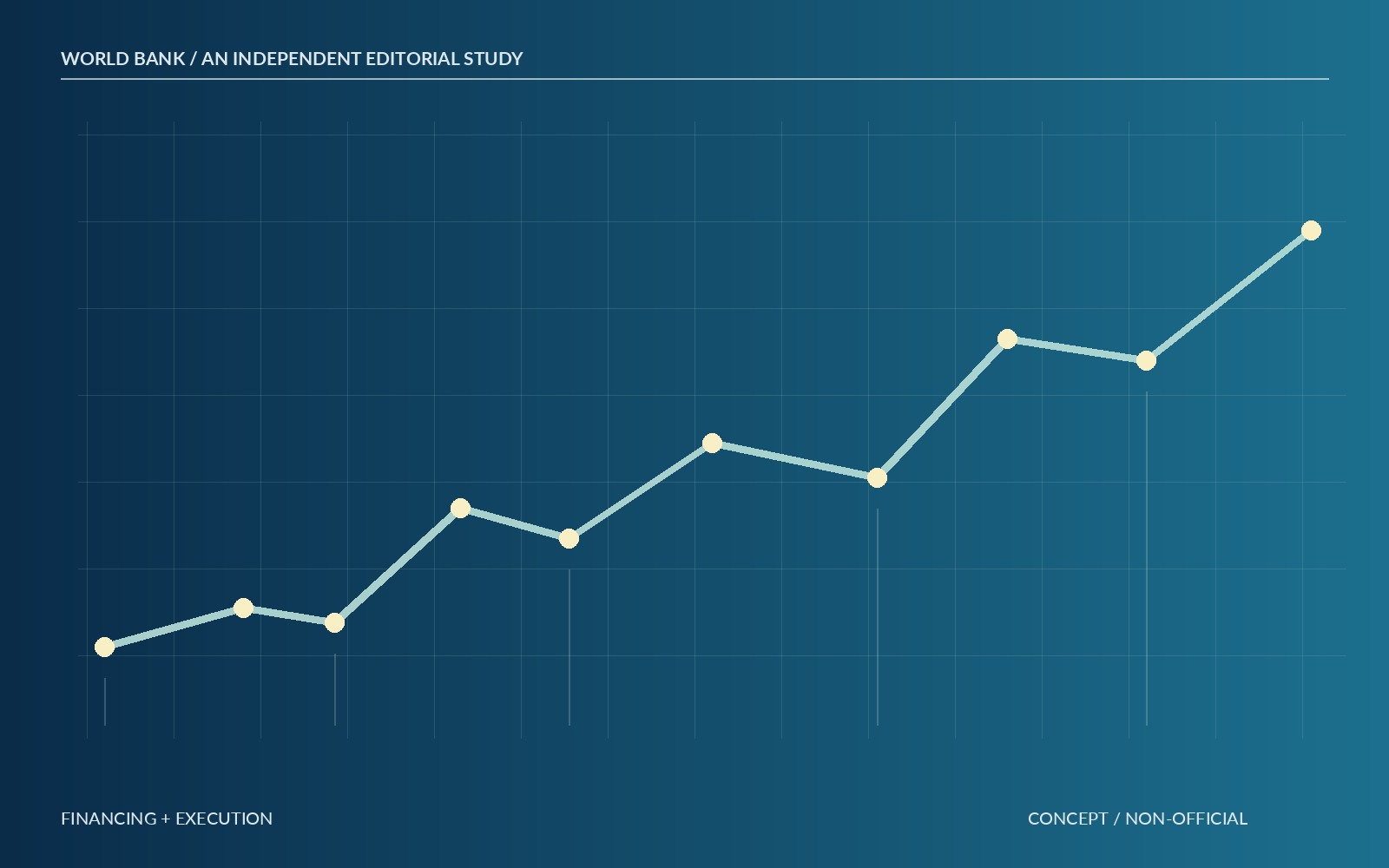
The World Bank works with member countries through financing and other forms of support. Its projects, policy work and research are distinct activities; a loan is not the same as a grant, and institutional support is not identical in every market.
Loans and guarantees
IBRD provides financing and financial products to eligible borrowers, with terms that depend on the instrument and country.
Concessional support
IDA supports eligible lower-income countries through credits and grants under applicable rules.
Research and advice
Analysis, data and technical assistance can influence how public investment and development policy are designed.
CHAPTER 04 / THE HUMAN SCALE
Where systems touch real life.
The themes below illustrate development concerns; the generated imagery is conceptual and should never be presented as documentation of a World Bank borrower, beneficiary or funded project.
People and public services
The test of a major program is not simply the size of the investment, but whether public services and opportunity become more accessible.
Reliable, sustainable energy
Energy investment raises intertwined questions of cost, resilience, access, climate and long-term upkeep.
Urban capacity
A city operates as overlapping systems of transport, housing, water, public finance and resilience.
Agriculture and adaptation
Agricultural productivity and resilience depend on environmental conditions, markets, infrastructure and local institutions.
AN EDITORIAL INTERLUDE / SCALE VS OUTCOME
A project is not the same as an impact.
Designing a compelling institutional narrative requires the discipline to separate commitments, disbursements, outputs and independently evaluated results.
“The essential design question is simple: can a global institution make complex work understandable without making it look simpler than it is?”Independent editorial analysis
HOW TO READ DEVELOPMENT WORK
A chain of decisions, not a magic formula.
This is an editorial framework for understanding public development projects, not the World Bank’s official approval, procurement or evaluation procedure.
Identify the constraint
Begin with a grounded problem: access, affordability, resilience, capability or service quality.
Choose the instrument
Financing terms, public budgets, debt exposure and incentives matter.
Deliver through institutions
Procurement, governance, capacity, safeguards and local participation shape delivery.
Measure meaningful change
Outcomes, trade-offs, maintenance and who benefits should be assessed over time.
CHAPTER 05 / VISUAL IDENTITY AND TRUST
Clarity is part of credibility.
The familiar globe motif and blue-led institutional identity are recognizable cues associated with the World Bank. Their meaning comes from consistency and public communication, but visual recognition should never be confused with evidence of policy effectiveness.
Global perspective
The globe is a useful visual shorthand for cross-border scope, but it cannot communicate local context on its own.
Institutional gravity
Structured typography, diagrams, publications and data-driven communications can express seriousness.
Legible evidence
Precise sources, definitions and methodology help claims withstand scrutiny.
Human consequences
The most persuasive story reconnects institutional action with the people affected.
Visual analysis is interpretive. Colors and artwork used in this feature are editorial approximations, not official World Bank design specifications.
UNDERSTANDING THE STRUCTURE
One name. Multiple functions.
These are organizational concepts rather than live financial figures.
IBRD
A development-finance institution.
IDA
Concessional development-finance institution.
IFC / MIGA
Separate World Bank Group institutions with private-sector investment and guarantee mandates.
ICSID
International centre for investment-dispute settlement.
CHAPTER 06 / THE WORK AHEAD
Progress carries trade-offs.
Debt sustainability, environmental and social effects, country ownership, institutional capacity and the distribution of benefits remain central debates. An editorial profile should leave room for both ambition and scrutiny.
CLOSING PERSPECTIVE
A bigger, more careful story.
For the World Bank, brand storytelling is most useful when it joins ambition with proof, and international scale with locally felt outcomes.
“The architecture of progress is not a building. It is the quality of the decisions, institutions and public outcomes that connect.”Independent editorial closing thought — not an official slogan
SOURCES / TRANSPARENCY
An independent profile—not an endorsement.
This is an editorial analysis, not a World Bank publication. Longstanding institutional facts should be verified using World Bank / World Bank Group “Who We Are” pages, official institutional history, IBRD and IDA information, and relevant project, results and evaluation records. No current lending figures, country rankings, leadership details or latest policy claims are asserted here. External reference: worldbank.org.
Every packaged image is independent conceptual artwork. Four photo-style details derive from AI-generated imagery; the remaining assets are original abstract illustrations. No graphic is an official logo, location-verified photograph or documentation of an actual Bank-financed project. This material is unaffiliated with and not endorsed by the World Bank or World Bank Group.